
Collection Square·Ring
White gold Square ring with Princess diamond, brilliant-cut diamond halo and shank
An eleven-point Princess at the center, sixteen brilliants framing it, ten on the shank.
Drawn and built by hand at the bench, in Tosi.
At the center a square diamond, closed in a setting that takes it on all four sides. Around it runs a square frame of brilliants, four to a side, with four ribs of metal that start from the corners of the setting and reach the outer corners. The setting stands raised above the shank, and in profile the space under the square stays empty; the shank carries five brilliants on each side, set into the thread of the metal, and thins as it goes down towards the bottom.
The square at the center is a Princess cut of eleven points of a carat, color F and clarity VVS: F is the last grade in the colorless band, VVS means inclusions that are found only at ten magnifications. The twenty-six brilliants of the surround and the shank come to twenty-two points in all, less than a point each: stones you count, not stones you weigh. Twenty-seven diamonds in all, on three grams thirty of eighteen-carat white gold.
The material
Weights and carats as the workshop declares them.
- Metals
- White gold 18kt 750‰
- Technique
- Made entirely by hand: the square setting of the Princess, the surround and the two rows on the shank mounted one stone at a time.
The diamonds
Natural. Position, cut, carats, colour and clarity.


How it is made
The words of the trade, one by one, explained to those who do not know them.
- Princess cut
- A square cut with the facets of the brilliant. It was born in the 1970s to waste less rough: from an octahedron you get much more of it than from a round, where the corners end up as dust. The weak point is the corners, which stay sharp: that is where a knock chips the stone, and for that reason the setting takes it on all four sides.
- Brilliant cut
- Fifty-seven facets calculated so that the light entering from above comes back from the same side. It is the cut that makes a diamond sparkle, and the reason a badly cut diamond stays dull.
I don't look at what others are doing: I would rather create in my own style. That is what makes our jewelry recognizable.
Fabio Gori — Anna Gioielli, Tosi
Made for you
Every ring is made to the size of the person who will wear it: we settle it together before work begins.
The goldsmith's workshop is also the place where made-to-measure jewellery is created and family pieces are restored: if you have an idea, or something you want brought back to how it was, that is where it starts.
A goldsmith's workshop in Tosi, on the slopes of the Pratomagno: Anna opened it in 1988, her sons Fabio and Francesco carry it on. Piercing, repoussé, chasing and burin engraving — the Florentine school, with the workshop in full view of the shop.
From the same family
Two ways to find pieces like this one.
-
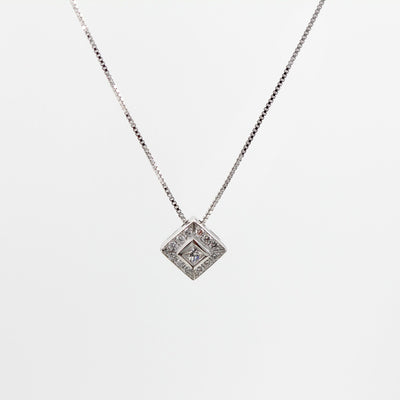
White gold Square pendant with Princess diamond and brilliant-cut diamond halo
€1.450,00
-
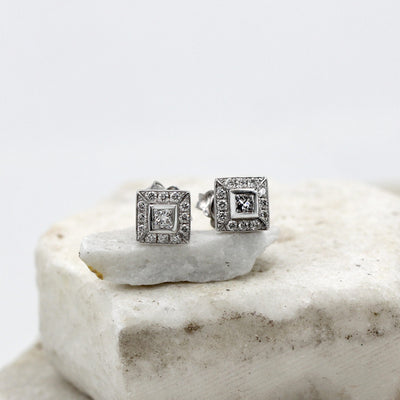
Square white gold earrings with a Princess-cut diamond and brilliant-cut diamond halo
€2.370,00
-

Fiore d'Inverno ring in silver with amethyst and yellow enamel, 14 mm corolla
€120,00
-

Fiore d'Inverno ring in bronze with garnet, blackened corolla and hammered band
€120,00
-

Marte faith ring in silver, 5.50 mm narrow band, pierced on a single row of empty spaces
€140,00
-

Fiore d'Inverno Ring in silver with citrine quartz, sinuous hammered wire shank
€150,00


From the same hands
See all (189)-

Marte ring in silver, pierced dome with a round coral and six gray diamonds
€1.470,00
-

Marte silver ring with round coral and eight gray diamonds, gold bezel
€1.480,00
-

Rinascimento silver and gold ring with oval amethyst and gray diamonds, leaf filigree
€2.030,00
-

Classic trilogy ring in white gold with three matching diamonds in a row
€2.490,00


