Amethyst
Center, in the gold setting with a beaded rim
- Cut
- Oval
- Note
- Natural

Collection Rinascimento·Anello·Florentine work, leaf design
Four gold bars carrying fifty-four hundredths of a carat of gray diamonds, over a piercing of silver leaves.
Drawn and built by hand at the bench, in Tosi.
The band is wide and domed, and it is not solid: the silver body is pierced with leaves, and on every leaf the veins are engraved with the burin. At the center, in a gold setting with a beaded rim, sits an oval amethyst laid lengthwise along the band, not along the finger. From the setting four gold bars step over the piercing towards the four corners of the band and run down the sides: along each one goes a row of gray diamonds. Inside, the ring returns smooth, because that is the part that sits on the finger.
The eighteen carat gold weighs three grams ninety, and it is not the structure: it makes the setting, the four bars and the edge of the band. All the rest — the body, the piercing, the leaves — is silver, and here it is the silver that takes the burin. The gray diamonds are natural, brilliant-cut, and add up to fifty-four hundredths of a carat: there are many of them and they are small, spread over four rows, and the gray sits beside the purple of the amethyst without competing with it for color.
Weights and carats as the workshop declares them.
Center, in the gold setting with a beaded rim
Natural. Position, cut, carats, colour and clarity.
Certificate Certificate of authenticity and guarantee · gift box


The words of the trade, one by one, explained to those who do not know them.
I don't look at what others are doing: I would rather create in my own style. That is what makes our jewelry recognizable.
Fabio Gori — Anna Gioielli, Tosi
Every ring is made to the size of the person who will wear it: we settle it together before work begins.
The goldsmith's workshop is also the place where made-to-measure jewellery is created and family pieces are restored: if you have an idea, or something you want brought back to how it was, that is where it starts.
A goldsmith's workshop in Tosi, on the slopes of the Pratomagno: Anna opened it in 1988, her sons Fabio and Francesco carry it on. Piercing, repoussé, chasing and burin engraving — the Florentine school, with the workshop in full view of the shop.
Due modi di cercare quello che somiglia a questo.

Acantus leaf carved filigree band ring in silver
€300,00

Florentine Style silver ring with 16.50 ct oval citrine quartz and sixteen surrounding citrines
€1.380,00

Asymmetric Rinascimento ring with cushion-cut amethyst, off-center gold bezel on filigree silver
€1.490,00

Rinascimento ring with 29-carat amethyst, openwork mesh silver, and yellow gold bezel
€1.900,00

Fiore d'Inverno ring in silver with amethyst and yellow enamel, 14 mm corolla
€120,00

Fiore d'Inverno ring in bronze with garnet, blackened corolla and hammered band
€120,00

Marte faith ring in silver, 5.50 mm narrow band, pierced on a single row of empty spaces
€140,00

Fiore d'Inverno Ring in silver with citrine quartz, sinuous hammered wire shank
€150,00

Classic trilogy ring in white gold with a larger central diamond and smaller side diamonds
€2.490,00

White and yellow gold ring with marquise peridot between two bands
€2.440,00

Daisy earrings in white gold, eight diamonds around the central brilliant-cut diamond
€2.380,00
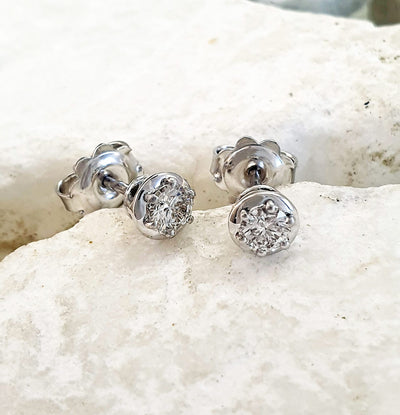
White gold solitaire stud earrings with a brilliant-cut diamond in a six-prong setting
€2.150,00