Peridot
At the center of the corolla
- Cut
- Round faceted
- Note
- Natural peridot, in a closed setting pierced at the back. Carat weight not stated

Collection Fiore d'Inverno·Ring
Twelve and a half grams of silver, with the corolla blackened inside so the green lifts off it
Drawn and built by hand at the bench, in Tosi.
A silver corolla hollowed from a single sheet, the rim left wavy and polished. Inside it is black: the cup is sandblasted and then blackened, and the grooves running out from the center stay dark inside it, one beside the next. In the middle, in a round polished setting, a faceted peridot of a green with yellow inside it. The shank is a single band, hammered to an irregular surface; behind, the back of the flower is left raw, carries the silver hallmark, and the setting is pierced at the base, so that looking inside the ring you see the point of the stone.
Twelve and a half grams of 925 silver, exactly one gram more than its brother with the green-enameled corolla: there the color is put in by glass, here by the black left in the recesses after the cloth has polished back the raised work. The peridot is the delicate part of the piece — it sits lower than the quartzes on the hardness scale — and in a closed setting it has to be settled by pressing a little at a time. The studio states neither the carat weight of the stone nor the diameter of the flower.
Weights and carats as the workshop declares them.
At the center of the corolla


The words of the trade, one by one, explained to those who do not know them.
I don't look at what others are doing: I would rather create in my own style. That is what makes our jewelry recognizable.
Fabio Gori — Anna Gioielli, Tosi
Every ring is made to the size of the person who will wear it: we settle it together before work begins.
The goldsmith's workshop is also the place where made-to-measure jewellery is created and family pieces are restored: if you have an idea, or something you want brought back to how it was, that is where it starts.
A goldsmith's workshop in Tosi, on the slopes of the Pratomagno: Anna opened it in 1988, her sons Fabio and Francesco carry it on. Piercing, repoussé, chasing and burin engraving — the Florentine school, with the workshop in full view of the shop.
Two ways to find pieces like this one.

Fiore d'Inverno ring in silver with amethyst and yellow enamel, 14 mm corolla
€120,00

Fiore d'Inverno ring in bronze with garnet, blackened corolla and hammered band
€120,00

Fiore d'Inverno silver earrings with iolite, 13 mm sandblasted corollas
€120,00

Fiore d'Inverno earrings in blackened bronze with garnet, 18mm corollas
€135,00
Fiore d'Inverno ring in silver with amethyst and yellow enamel, 14 mm corolla
€120,00
Fiore d'Inverno ring in bronze with garnet, blackened corolla and hammered band
€120,00

Marte faith ring in silver, 5.50 mm narrow band, pierced on a single row of empty spaces
€140,00

Fiore d'Inverno Ring in silver with citrine quartz, sinuous hammered wire shank
€150,00
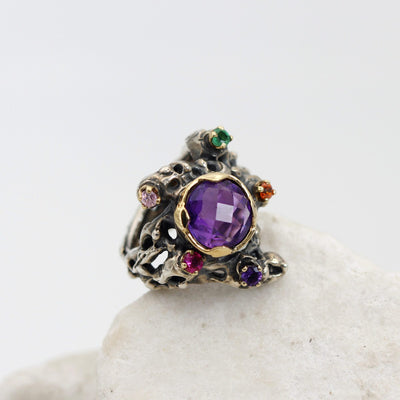
Marte ring in oxidized silver and gold with checkerboard amethyst and five colored stones
€1.175,00

Fiore d'Inverno earrings in silver with rhodolite, 13 mm corollas
€130,00

Marte ring in perforated sterling silver with a heart-shaped black onyx
€235,00

Prestige gold ring with crossover lines and diamonds
€4.460,00