Cubic zirconia
Set in the seats between the holes, on the face of the heart
- Cut
- Brilliant
- Note
- 29 stones; the carat weight and the origin are not stated by the company

Collection Jewels of Firenze·Pendant·Florentine style, net piercing
Twenty-nine cubic zirconia set between the holes of a net that pierces the heart right through, and the chain that runs inside it.
Drawn and built by hand at the bench, in Tosi.
A domed silver heart, high at the center and thinned towards the edges, pierced right through. The holes are round and sit in staggered rows, as close as the cells of a honeycomb; the sheet between one hole and the next does not stay smooth, because where four holes meet the metal forms a pointed seat and inside the seat a zircon is set, and around it the burin opens a short radiating pattern of grooves. The edge of the heart is a thin band, finished in fine lines. Behind, the heart is hollow: the same net of holes runs on the back as well, but there the seats stay bare, and through the holes you see the chain passing inside. Low down, on the back, is the plaque with the hallmarks. The chain goes through the heart instead of holding it suspended, entering and leaving at the two sides through two passages finished in yellow gold, and the heart runs along it.
Nine grams twenty of silver at nine hundred and twenty-five thousandths — the company states a single weight, without separating the heart from the chain — for a heart of twenty-eight millimeters by twenty-five. The cubic zirconia are twenty-nine, brilliant cut, set one by one; the carat weight the company does not state, and we do not add it. «Zirconi» is the word used by whoever made the piece, and it is the one we use as well: in Italian it covers both zircon, which is a natural mineral, and cubic zirconia, which is grown in a laboratory, and which of the two this is is not written. The eighteen-carat yellow gold sits only in the two chain passages: a few millimeters, of undeclared weight, and it is the point the metal rubs against every time the heart runs. The chain is a square link and is worn at two lengths, forty-two and a half centimeters or fifty, with no clasp to move. On request the same model is made in eighteen-carat gold, with brilliants in place of the cubic zirconia.
Weights and carats as the workshop declares them.
Set in the seats between the holes, on the face of the heart


The words of the trade, one by one, explained to those who do not know them.
I don't look at what others are doing: I would rather create in my own style. That is what makes our jewelry recognizable.
Fabio Gori — Anna Gioielli, Tosi
Every piece leaves the bench made to order: sizes and details are agreed before the work begins.
The goldsmith's workshop is also the place where made-to-measure jewellery is created and family pieces are restored: if you have an idea, or something you want brought back to how it was, that is where it starts.
A goldsmith's workshop in Tosi, on the slopes of the Pratomagno: Anna opened it in 1988, her sons Fabio and Francesco carry it on. Piercing, repoussé, chasing and burin engraving — the Florentine school, with the workshop in full view of the shop.
Two ways to find pieces like this one.

Openwork heart pendant in rhodium-plated sterling silver with fifty-two cubic zirconia and rope chain
€680,00

White and yellow gold cross pendant, openwork and hand-engraved leaves
€1.260,00

White and yellow gold band ring with diamonds, openwork mesh between engraved borders
€3.260,00
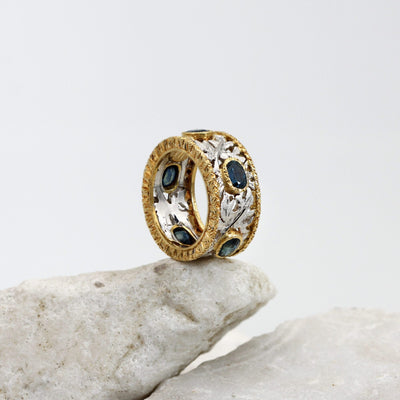
White and yellow gold wedding band with sapphires and floral openwork
€3.990,00

Silver pendant with cabochon amethyst drop and faceted oval peridot, chain included
€120,00

Starfish Marte pendant in oxidized and perforated silver, 38 cm chain included
€130,00

Hammered silver heart pendant with two-tone purple enamel rhombuses, silk cord included
€180,00

Open teardrop silver pendant with freshwater pearl, on a green silk cord
€175,00


