
Collection Jewels of Firenze·Pendant·Florentine style
White and yellow gold cross pendant, openwork and hand-engraved leaves
Four grams thirty of gold for four centimeters six of cross: the saw took away the rest.
Drawn and built by hand at the bench, in Tosi.
The cross is white gold and the arms are cut out with the saw in a pattern of leaves, with the voids opened right through, and every leaf is engraved with the burin one at a time. The four ends finish in leaves too. At the center of the crossing a yellow gold rosette is mounted; the jump ring is yellow gold as well, engraved with the same mark.
Four centimeters six tall including the jump ring, two centimeters four wide, four grams thirty of eighteen carat gold divided between the two colors. For a cross of this size that is a modest weight, and what makes it so is the emptiness: here the leaves are not an ornament laid on top, they are the structure, and it is they that hold the arms together.
The material
Weights and carats as the workshop declares them.
- Metals
- White and yellow gold 18kt 750‰
- Style
- Florentine style
- Dimensions
- 46 × 24 mm (with the jump ring)
- Technique
- Made entirely by hand, with piercing and burin engraving.


How it is made
The words of the trade, one by one, explained to those who do not know them.
- Openwork
- The metal is drilled and then cut out from the inside with a very fine saw, until the solid sheet becomes a drawing of voids. It is a technique that allows no second attempt: what is taken away does not come back.
- Burin engraving
- The burin is a goldsmith's small chisel pushed by hand. It does not scratch: it lifts a shaving of metal and leaves a clean groove that picks up the light. It is the mark that for five centuries has distinguished the Florentine goldsmithing school.
- Two golds on the same piece
- White and yellow have different hardnesses and different soldering temperatures: setting them together means working two metals that do not react the same way under the flame, and making them meet without the joint showing.
I don't look at what others are doing: I would rather create in my own style. That is what makes our jewelry recognizable.
Fabio Gori — Anna Gioielli, Tosi
Made for you
Every piece leaves the bench made to order: sizes and details are agreed before the work begins.
The goldsmith's workshop is also the place where made-to-measure jewellery is created and family pieces are restored: if you have an idea, or something you want brought back to how it was, that is where it starts.
A goldsmith's workshop in Tosi, on the slopes of the Pratomagno: Anna opened it in 1988, her sons Fabio and Francesco carry it on. Piercing, repoussé, chasing and burin engraving — the Florentine school, with the workshop in full view of the shop.
From the same family
Two ways to find pieces like this one.
-

Mesh openwork silver heart pendant with twenty-nine cubic zirconia and sliding chain
€440,00
-

Openwork heart pendant in rhodium-plated sterling silver with fifty-two cubic zirconia and rope chain
€680,00
-

White and yellow gold band ring with diamonds, openwork mesh between engraved borders
€3.260,00
-
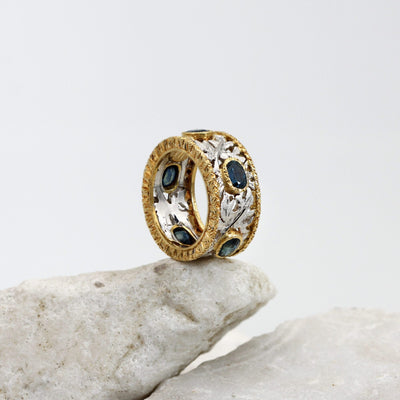
White and yellow gold wedding band with sapphires and floral openwork
€3.990,00


-

Silver pendant with cabochon amethyst drop and faceted oval peridot, chain included
€120,00
-

Starfish Marte pendant in oxidized and perforated silver, 38 cm chain included
€130,00
-

Hammered silver heart pendant with two-tone purple enamel rhombuses, silk cord included
€180,00
-

Open teardrop silver pendant with freshwater pearl, on a green silk cord
€175,00


From the same hands
See all (189)-

Florentine Style silver ring with 16.50 ct oval citrine quartz and sixteen surrounding citrines
€1.380,00
-
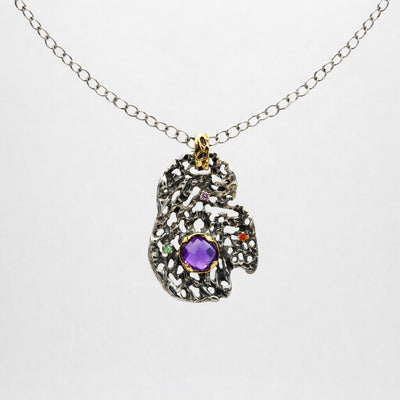
Oxidized silver and gold Marte pendant with faceted amethyst and three colored stones
€1.300,00
-
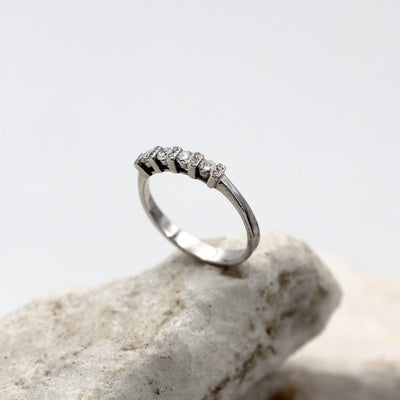
White gold "Traversine" ring with four brilliant-cut diamonds weighing six cents each
€1.380,00
-

Asymmetric Rinascimento ring with cushion-cut amethyst, off-center gold bezel on filigree silver
€1.490,00

