Citrine quartz
At the center of each earring
- Cut
- Checkerboard
- Carats
- ct 8,00
- Note
- Total for the two stones

Collection Marte·Earrings
Two checkerboard citrines, eight carats in all, on oxidized silver.
Drawn and built by hand at the bench, in Tosi.
The body of the earring is oxidized silver: a sheet pierced and hollowed, with the raised work polished and the recesses left black. At the center, inside a yellow gold setting, sits a round citrine cut checkerboard — the grid of little squares you can see on the crown of the stone. Citrine is a quartz, yellow by nature: the trade sometimes calls it topaz, but topaz is a different mineral. On the dark metal, around the stone, the diamonds are held one by one in small gold seats.
The two citrines come to eight carats in all. The natural diamonds, brilliant-cut and gray in color, reach forty-one hundredths. The silver at nine hundred and twenty-five thousandths weighs eleven grams ten, the eighteen carat yellow gold seven sixty: the silver makes the body, the gold holds the stones. Each earring measures twenty millimeters by twenty-three and fastens with a post and an omega clip.
Weights and carats as the workshop declares them.
At the center of each earring
Natural. Position, cut, carats, colour and clarity.


The words of the trade, one by one, explained to those who do not know them.
I don't look at what others are doing: I would rather create in my own style. That is what makes our jewelry recognizable.
Fabio Gori — Anna Gioielli, Tosi
Every piece leaves the bench made to order: sizes and details are agreed before the work begins.
The goldsmith's workshop is also the place where made-to-measure jewellery is created and family pieces are restored: if you have an idea, or something you want brought back to how it was, that is where it starts.
A goldsmith's workshop in Tosi, on the slopes of the Pratomagno: Anna opened it in 1988, her sons Fabio and Francesco carry it on. Piercing, repoussé, chasing and burin engraving — the Florentine school, with the workshop in full view of the shop.
Two ways to find pieces like this one.

Marte faith ring in silver, 5.50 mm narrow band, pierced on a single row of empty spaces
€140,00

Starfish Marte pendant in oxidized and perforated silver, 38 cm chain included
€130,00

Marte ring in domed silver band, round perforated dome with raised dots
€150,00

Marte ring in domed sphere-shaped silver, perforated dotted shell
€220,00
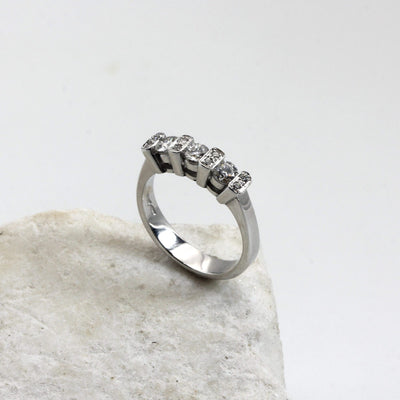
Trilogy ring Traversine in white gold with three identical brilliant-cut diamonds
€2.800,00

Marte earrings in oxidized silver and gold with faceted amethyst and diamonds
€2.815,00
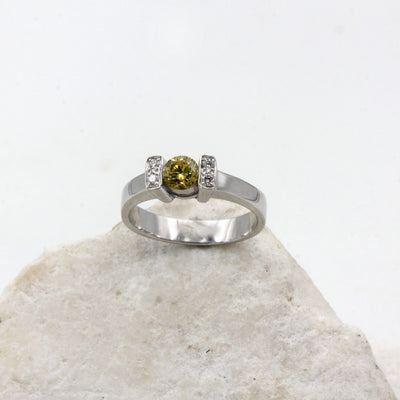
Traversine Solitaire Ring in White Gold with Natural Yellow Diamond
€2.800,00

White and yellow gold band ring with diamonds, openwork mesh between engraved borders
€3.260,00


