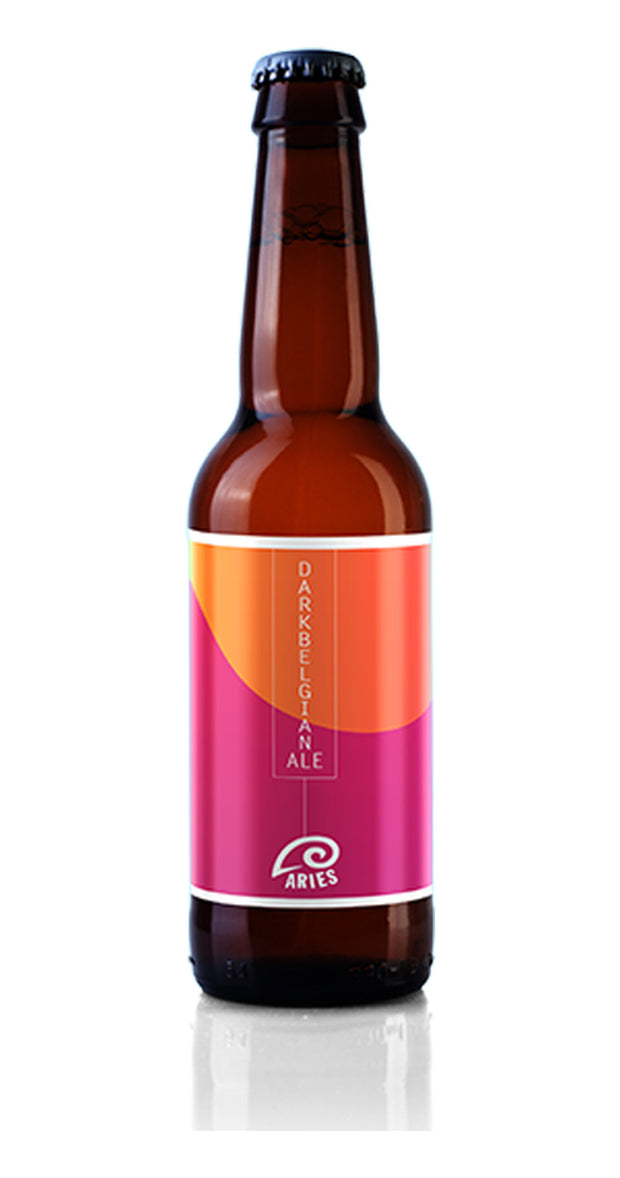
Neptunus
33 cl bottle
Powerful yet soft at the same time, with a dried fruit finish
€5,50
What it is, and what is in it
Seven unannounced degrees: Neptunus is powerful yet soft, and the softness comes from Belgian fermentation, which leaves a roundness where another beer would have an alcoholic edge.
The color is intense amber. The nose offers full-bodied fruit with a light spicy note; in the mouth, a sweetness reminiscent of dried fruit emerges, and beneath it are forty units of bitterness that hold everything together without being noticeable.
In the brewery's catalog, this beer shares its technical specifications with Tĕrra and is sold as a separate reference. Top-fermented, unfiltered, unpasteurized.
- Ingredients
- Water, barley malt, wheat, sugar, hops, yeast.
- Allergens
- Gluten (barley malt, wheat).
What the brewery drinks it with
The pairings declared for this beer.
- Rich dishes
- Aged cheeses
- Fruit desserts
The label’s terms, explained
What a Dark Belgian Ale is
Not a style with a set of rules, but a family: the dark ales of the Belgian school, high in strength and round instead of angular. What holds them together is the yeast, not the malt — and the consequence is that seven degrees, in a beer like this, do not reach the nose as alcohol but as fruit and spice.
Belgian yeast
The strains used in Belgium work at higher temperatures than average and, in doing so, produce esters and phenols: molecules that on the nose resemble ripe fruit, dried fruit, clove, pepper. They are not added flavorings, they are a by-product of fermentation. It is the reason two beers with the same malts and the same hops, fermented with different yeasts, taste of two different things.
Wheat in a barley beer
Alongside barley malt, the brewery states wheat. Wheat brings more protein than barley, and protein holds up the head: a beer with wheat makes a denser and longer-lasting head, and gives a fuller feel in the mouth. It is a cereal with gluten, and for that reason it appears among the allergens together with barley.
The Plato degree
It measures the sugars dissolved in the wort before the yeast starts to work: one degree Plato is one gram of extract in every hundred grams of wort. Seventeen is a dense wort — an ordinary blonde starts at eleven or twelve — and it is from there that both the seven degrees and the full body come.
What IBUs are
International Bitterness Units: the laboratory measurement of the bittering substances given up by the hop. An industrial pale lager sits around 10-20, a pale ale between 30 and 45, a modern IPA often passes 60. It is not a scale of taste: on a dense wort with residual sugars the same number is felt less, because the sweetness covers part of it.
What it says on the bottle
The mandatory label information, transcribed from the label of the size on sale.
- Ingredients
- Water, barley malt, wheat, sugar, hops, yeast.
- Allergens
- Gluten (barley malt, wheat).
- Contents
- 33 cl bottle
- Place of production
- Produced in San Pierino, Fucecchio (FI)
| Energy | 254 kJ / 61 kcal |
|---|---|
| Fat | 0 g |
| of which saturated fatty acids | 0 g |
| Carbohydrate | 3,6 g |
| of which sugars | 0,9 g |
| Protein | 0,5 g |
| Salt | <0,01 g |
| Alcohol (ethanol) | 5,5 g |
Where and how it is made
Daniele Nespeca, per Birrificio Aries, in Fucecchio.
A two-hectoliter brew · from barley to bottle, all in house
All 76 products by Birrificio Aries- How it is made
- Selection of raw materials, barley milling, mashing, filtration, whirlpool, yeast pitching, primary fermentation in fermenter, secondary fermentation in bottle or keg. All stages on-site: 2 hl brew kettle and two 600 l temperature-controlled stainless steel conical fermenters.
- Other sizes
- 33 cl bottle; 24 l keg.
The brewery’s other beers
Gli elementi




Le speciali
