
Aqua
Golden Ale · 33 cl bottle
Unfiltered blonde, with Bohemian Saaz hops.
€4,40
What it is, and what is in it
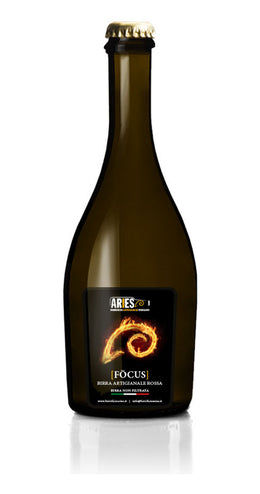
Aqua is one of the four beers named after the elements—along with Aëra, Tĕrra, and Fŏcus—the first ones the brewery produced, starting in 2018. The names that came later went up into the sky: Jupiter, Venus, Mercurius, Saturnus, Neptunus, Andromeda.
Five ingredients in the recipe, no additives, and no preservatives. The hop declared by the brewery is Saaz.
- Hops
- Saaz
- Fermentation
- Top fermentation, natural bottle conditioning
- Filtration
- Unfiltered, unpasteurized
- Ingredients
- Water, barley malt, hops, sugar, yeast.
- Allergens
- Gluten (barley malt).
What it is like
Color
Pale gold
What the brewery drinks it with
The pairings declared for this beer.
- Savory pies
- Pizza
- Cured meats
- Vegetables
- Fried fish
- Canapés
- Pasta dishes
The label’s terms, explained
What a Golden Ale is
A pale, top-fermented beer, in color between straw and gold. The style established itself in Britain from the mid-Eighties, when breweries went looking for a pale, easy-drinking beer to set against the industrial lagers. Medium-light body, bitterness present but restrained compared with an IPA, hops that show in the aroma more than in the mouth. It is a beer to drink young: it is not made to age.
The Saaz hop
It takes its name from Žatec — Saaz in German — the town in north-western Bohemia where it has been grown for centuries. It is one of the four European hops called “noble”, along with Hallertau, Tettnang and Spalt: they give little bitterness and a great deal of aroma, grassy and spicy. It is the hop on which the Czech tradition of pale beers, Pilsner included, is built.
Unfiltered, unpasteurized, bottle conditioned
They are three separate things. Unfiltered: after fermentation the beer does not pass through filters, and the yeast stays in suspension. Unpasteurized: it is not heated to stop the biological activity. Bottle conditioned: a last dose of sugar is added and the yeast produces the carbon dioxide inside the closed bottle, instead of receiving it from a plant. The practical consequence: a veil of yeast settles at the bottom. You can leave it in the bottle by pouring slowly, or pour it out with the rest, and then the beer comes out cloudier.
What IBUs are
International Bitterness Units: the laboratory measure of the bittering compounds the hops have given to the beer. As an order of magnitude: an industrial pale lager sits around 10-20, a pale ale between 30 and 45, a modern IPA often goes past 60. It is not a scale of taste: at the same IBU a beer with more malt seems less bitter, because the sweetness compensates.
Degrees Plato
It measures the sugars dissolved in the wort before the yeast starts to work: one degree Plato is equal to one gram of extract per hundred grams of wort. It is from there that the alcohol the yeast will be able to produce, and the body the beer will have in the glass, both follow.
What it says on the bottle
The mandatory label information, transcribed from the label of the size on sale.
- Designation
- Blonde craft beer
- Ingredients
- Water, barley malt, hops, sugar, yeast.
- Allergens
- Gluten (barley malt).
- Alcoholic strength
- 5% vol.
- Contents
- 33 cl bottle
- Place of production
- Produced in San Pierino, Fucecchio (FI)
| Energy | 175 kJ / 42 kcal |
|---|---|
| Fat | 0 g |
| of which saturates | 0 g |
| Carbohydrate | 3,1 g |
| of which sugars | 0,5 g |
| Protein | 0,4 g |
| Salt | <0,01 g |
Where and how it is made
Daniele Nespeca, per Birrificio Aries, in Fucecchio.
A two-hectoliter brew · from barley to bottle, all in house
All 76 products by Birrificio Aries- How it is made
- Selection of raw materials, barley milling, mashing, filtration, whirlpool, yeast pitching, primary fermentation in fermenter, secondary fermentation in bottle or keg. All stages on-site: 2 hl brew kettle and two 600 l temperature-controlled stainless steel conical fermenters.
- Other sizes
- 33 cl and 75 cl bottle; 24 l and 30 l keg.
The brewery’s other beers
Gli elementi




Le speciali
