Baroque pearl
Body of the pendant
- Note
- Diameter 16,30 mm

Collection Marte·Pendant
Sixteen millimeters thirty of baroque pearl: the whole width of the pendant is the pearl.
Drawn and built by hand at the bench, in Tosi.
The pearl is the large part: a white baroque with an irregular outline, one side slightly flattened, a shallow groove running round the body and a few round dimples on the surface. The white does not stay still — it turns to pink and lilac where the light runs, and towards the bottom it shifts to cream. Above, a silver cap holds it, modeled into craters and opened into irregular voids: no hole resembles the one beside it, and the arms come down over the shoulders of the pearl without projecting at the sides. The silver is oxidized in the recesses and re-polished only on the raised areas, as in all the Marte pieces: the design comes forward by contrast. On the front of the cap, held by four polished claws, sits a blue oval sapphire. At the top the suspension ring is of the same pierced silver, and a blue silk cord passes through it.
The pendant measures thirty-one millimeters by sixteen, and the pearl measures sixteen thirty across: the width is all pearl, the silver sits above it and not beside it. Four grams sixty of silver, and fifty-seven points of a carat of sapphire. The shape is the one the oyster laid down, and the cap was built onto this pearl, so the piece cannot be made again the same. The nacre, though, is soft — it scratches with a fingernail — and it is afraid of acids: perfume, hairspray and sweat dull it, and it must be put away dry. The blue silk cord with silver ends that appears in the photographs is fifty-one centimeters long.
Weights and carats as the workshop declares them.
Body of the pendant
On the front of the cap, on four claws


The words of the trade, one by one, explained to those who do not know them.
I don't look at what others are doing: I would rather create in my own style. That is what makes our jewelry recognizable.
Fabio Gori — Anna Gioielli, Tosi
Every piece leaves the bench made to order: sizes and details are agreed before the work begins.
The goldsmith's workshop is also the place where made-to-measure jewellery is created and family pieces are restored: if you have an idea, or something you want brought back to how it was, that is where it starts.
A goldsmith's workshop in Tosi, on the slopes of the Pratomagno: Anna opened it in 1988, her sons Fabio and Francesco carry it on. Piercing, repoussé, chasing and burin engraving — the Florentine school, with the workshop in full view of the shop.
Two ways to find pieces like this one.

Marte faith ring in silver, 5.50 mm narrow band, pierced on a single row of empty spaces
€140,00

Starfish Marte pendant in oxidized and perforated silver, 38 cm chain included
€130,00

Marte ring in domed silver band, round perforated dome with raised dots
€150,00

Marte ring in domed sphere-shaped silver, perforated dotted shell
€220,00

Silver pendant with cabochon amethyst drop and faceted oval peridot, chain included
€120,00
Starfish Marte pendant in oxidized and perforated silver, 38 cm chain included
€130,00

Hammered silver heart pendant with two-tone purple enamel rhombuses, silk cord included
€180,00

Open teardrop silver pendant with freshwater pearl, on a green silk cord
€175,00
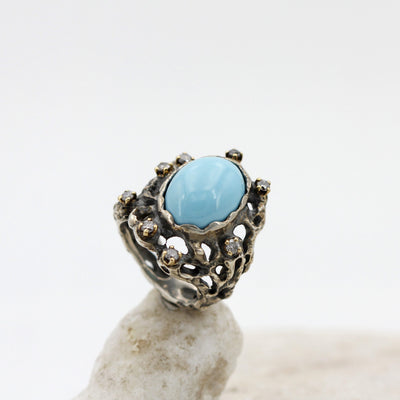
Domed, openwork Marte ring with a turquoise in a silver bezel and eight gray diamonds all around
€590,00

Marte ring in oxidized silver and gold with oval cabochon amethyst and eight colored stones
€760,00
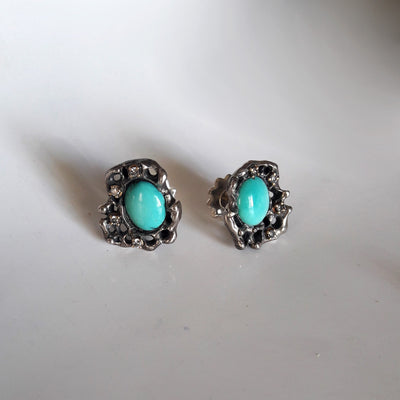
Marte earrings in oxidized silver with oval cabochon turquoise and eight gray diamonds in gold bezels
€680,00

Marte ring in oxidized silver with oval cabochon ruby and eight gray diamonds in gold bezels
€1.080,00