
Collection Autumnia·Anello·Florentine work, leaf design
Silver band ring with engraved interwoven leaves
Twelve grams of silver and no stones: the whole piece is in the furrows left by the burin.
Drawn and built by hand at the bench, in Tosi.
The band is wide: worn, it covers almost the whole knuckle, and it has not a single smooth stretch. It is made of leaves that overlap one another and run right around the finger, with no front and no back. Every leaf has its central vein in relief, left polished, and from it run the burin strokes that go obliquely towards the edge: short, close together, all leaning the same way. Between one furrow and the next the ground is stippled and stays matt, and that is where the point of the design lies — the matt holds the light, the furrow sends it back. The edges are not cut straight but toothed, and the odd leaf lifts or folds over its neighbor. Underneath, where the finger passes, the band is not solid: it is parallel silver wires, and between them you can see through.
Twelve grams of silver, and no stones. Everything there is to look at was put there by the hand that pushed the burin, one furrow at a time: on a band of this width the furrows run into the hundreds, and none of them can be gone over again, because returning twice to the same mark widens its edge and the mark stops catching the light. The burin does not stop where the eye stops: the leaves that stay underneath, and those you only see by turning the ring, are engraved like the others, and the engraving carries on over the fold that faces inside the band.
The material
Weights and carats as the workshop declares them.
- Metals
- Silver 925‰
- Style
- Florentine work, leaf design
- Technique
- Made entirely by hand in the maker's goldsmith studio: the leaves shaped and curved one by one, the ground stippled and the veins engraved with the burin.


How it is made
The words of the trade, one by one, explained to those who do not know them.
- Burin engraving
- The burin is a goldsmith's small chisel, pushed by hand. It does not scratch: it lifts a shaving of metal and leaves a clean furrow that catches the light. It is the mark that for five centuries has set the Florentine goldsmiths' school apart.
- Repoussé and chasing
- Repoussé raises the relief by beating the metal from the back; chasing finishes it from the front, with points that do not cut but move the metal. The work is done on a sheet that has to give just enough and no more: too strong a blow thins it on the other side, and where the metal is already pierced that point can no longer be strengthened.
- Stippled ground
- The ground between one engraved line and the next is not left smooth: it is struck with a round point until the metal is covered in close grains and stops mirroring. It is there to let the rest be seen — on a polished ground the furrows of the burin would be lost in the reflection, on a stippled ground they are the only thing that sends the light back. It is worked after the engraving and a hair's breadth from the furrows: a grain that slips into the line eats away its clean edge, and an eaten edge cannot be re-sharpened, because to redo it you would have to take more metal from a sheet that is already thin.
I don't look at what others are doing: I would rather create in my own style. That is what makes our jewelry recognizable.
Fabio Gori — Anna Gioielli, Tosi
Made for you
Every ring is made to the size of the person who will wear it: we settle it together before the work begins.
The goldsmith's workshop is also the place where made-to-measure jewellery is created and family pieces are restored: if you have an idea, or something you want brought back to how it was, that is where it starts.
A goldsmith's workshop in Tosi, on the slopes of the Pratomagno: Anna opened it in 1988, her sons Fabio and Francesco carry it on. Piercing, repoussé, chasing and burin engraving — the Florentine school, with the workshop in full view of the shop.
Della stessa famiglia
Due modi di cercare quello che somiglia a questo.
-

Fiore d'Inverno ring in silver with amethyst and yellow enamel, 14 mm corolla
€120,00
-

Fiore d'Inverno ring in bronze with garnet, blackened corolla and hammered band
€120,00
-

Marte faith ring in silver, 5.50 mm narrow band, pierced on a single row of empty spaces
€140,00
-

Fiore d'Inverno Ring in silver with citrine quartz, sinuous hammered wire shank
€150,00


Dalle stesse mani
See all (189)-

Marte pendant in oxidized silver with white baroque pearl and oval sapphire
€530,00
-
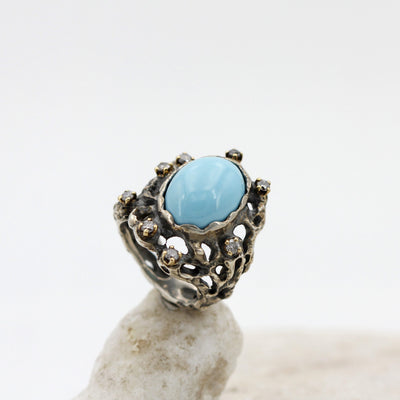
Domed, openwork Marte ring with a turquoise in a silver bezel and eight gray diamonds all around
€590,00
-

Marte ring in oxidized silver and gold with oval cabochon amethyst and eight colored stones
€760,00
-
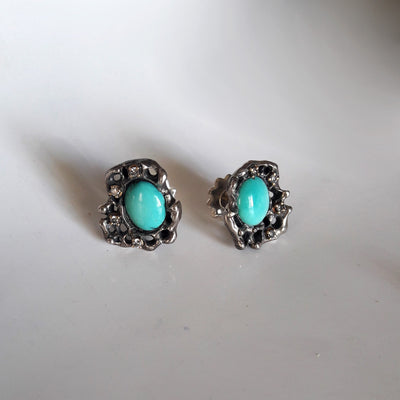
Marte earrings in oxidized silver with oval cabochon turquoise and eight gray diamonds in gold bezels
€680,00


