Amethyst
One drop per earring, hanging from the silver cap
- Cut
- Polished drop, without facets
- Note
- Natural amethysts, diameter 7,98 mm

Collection Marte·Earrings
Sixty millimeters from lobe to tip, and the posts are gold so the silver never touches the ear.
Drawn and built by hand at the bench, in Tosi.
Each earring is made of three pieces hung one from another. At the top, on the lobe, there is a silver leaf from which all the tissue has been taken away: the central rib and the side veins are left, curving and closing back on the edge, and the void in between. The silver is oxidized in the recesses and polished back along the veins, as in all the Marte pieces, and through the voids you can see the yellow of the post behind. Below, hanging from a ring that lets it swing, there is a cap of the same silver hollowed into craters, with a few round beads on the raised work: it closes onto the shoulder of the drop and holds it. The drop is amethyst, long and tapered, with no facets, a continuous polished surface that narrows at the top and closes round at the bottom. The purple is not even — it runs in bands, paler and darker — and inside the stone you can see veining and a few small dark inclusions.
From lobe to tip the earring measures sixty millimeters, and more than half that length is stone; the drop is seven millimeters and ninety-eight hundredths across. Ten grams fifty of silver at nine hundred and twenty-five thousandths make the two leaves and the two caps. The eighteen carat yellow gold is ninety hundredths of a gram and is all in the posts that pass through the lobe: it is not an ornament, it is the decision not to let silver touch skin, and from the front the gold is barely visible. Amethyst is quartz, and its purple comes from iron that entered the lattice while the crystal was growing: that is why the color runs in bands instead of being solid, and why a stone is chosen one at a time, looking at where the dark band falls. It is also a color that wears out — heat turns it and strong, continuous light slowly puts it out — so the earrings are not left in the sun on the windowsill.
Weights and carats as the workshop declares them.
One drop per earring, hanging from the silver cap


The words of the trade, one by one, explained to those who do not know them.
I don't look at what others are doing: I would rather create in my own style. That is what makes our jewelry recognizable.
Fabio Gori — Anna Gioielli, Tosi
Every piece leaves the bench made to order: sizes and details are agreed before the work begins.
The goldsmith's workshop is also the place where made-to-measure jewellery is created and family pieces are restored: if you have an idea, or something you want brought back to how it was, that is where it starts.
A goldsmith's workshop in Tosi, on the slopes of the Pratomagno: Anna opened it in 1988, her sons Fabio and Francesco carry it on. Piercing, repoussé, chasing and burin engraving — the Florentine school, with the workshop in full view of the shop.
Two ways to find pieces like this one.

Marte faith ring in silver, 5.50 mm narrow band, pierced on a single row of empty spaces
€140,00

Starfish Marte pendant in oxidized and perforated silver, 38 cm chain included
€130,00

Marte ring in domed silver band, round perforated dome with raised dots
€150,00

Marte ring in domed sphere-shaped silver, perforated dotted shell
€220,00

Sterling silver floral scroll ring with 12.81mm gray Tahitian pearl
€380,00

Prestige pendant in white and yellow gold, openwork cushion with integrated chain
€2.810,00
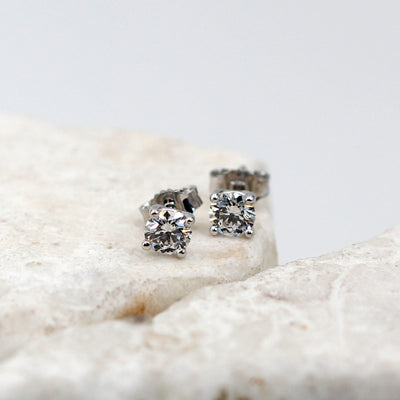
White gold solitaire earrings with lab-grown diamonds
€1.350,00

Hollow sphere pendant in sterling silver with crater perforations, on a leather cord
€390,00


