Iolite
On the six strands, and at the center of one flower of the clasp
- Colour
- Blu-violetto
- Note
- Natural stone, strung by hand. Carat weight not declared

Collection Fiore d'Inverno·Necklace·Floral motif drawn from winter flowers
Six strands of iolite and labradorite, and the clasp is the bunch of silver flowers worn to one side.
Drawn and built by hand at the bench, in Tosi.
Six strands of iolite strung by hand, and between one bead and the next the white labradorite breaking the purple. The color is never even: within the same strand it runs from a full blue-violet to beads that are almost colorless, and the sequence never comes back the same. The strands are not all the same length, the shortest is the inner one, and they fall one below the other. The clasp sits at one side, and it is a group of silver corollas with wavy rims, each with a single stone at the center: orange citrine quartz, purple amethyst, blue iolite, dark red ruby root, green peridot.
Thirty-one grams and fifty of silver 925, and fifty-two centimeters measured on the inner strand: the other five are progressively longer, and the fan opens below the throat. The ends of the strands are not knotted together: each is wound onto a ring soldered to the back of a corolla, and from there the weight passes to the hook. On the reverse the settings are open — the light passes through the stones instead of stopping on a back — and beside the holes are the silver hallmarks. The studio declares the carat weight of none of the gems.
Weights and carats as the workshop declares them.
On the six strands, and at the center of one flower of the clasp
On the six strands, alternating with the iolite
On the flowers of the clasp
On the flowers of the clasp
On the flowers of the clasp
On the flowers of the clasp


The words of the trade, one by one, explained to those who do not know them.
I don't look at what others are doing: I would rather create in my own style. That is what makes our jewelry recognizable.
Fabio Gori — Anna Gioielli, Tosi
Every piece leaves the bench made to order: sizes and details are agreed before the work begins.
The goldsmith's workshop is also the place where made-to-measure jewellery is created and family pieces are restored: if you have an idea, or something you want brought back to how it was, that is where it starts.
A goldsmith's workshop in Tosi, on the slopes of the Pratomagno: Anna opened it in 1988, her sons Fabio and Francesco carry it on. Piercing, repoussé, chasing and burin engraving — the Florentine school, with the workshop in full view of the shop.
Two ways to find pieces like this one.

Fiore d'Inverno ring in silver with amethyst and yellow enamel, 14 mm corolla
€120,00

Fiore d'Inverno ring in bronze with garnet, blackened corolla and hammered band
€120,00

Fiore d'Inverno silver earrings with iolite, 13 mm sandblasted corollas
€120,00

Fiore d'Inverno earrings in blackened bronze with garnet, 18mm corollas
€135,00

Single-strand choker necklace with faceted pink and aquamarine morganite, two-calla lily silver clasp
€180,00

Single strand freshwater white pearl choker necklace, individually hand-knotted
€210,00

Four-strand labradorite and onyx necklace with oxidized silver frog clasp
€480,00

Fiore d'Inverno necklace in silver with eleven corollas, cascade of three flowers in the center
€650,00

Marte ring in silver and gold with seven yellow sapphires around a diamond and blue sapphires
€1.150,00
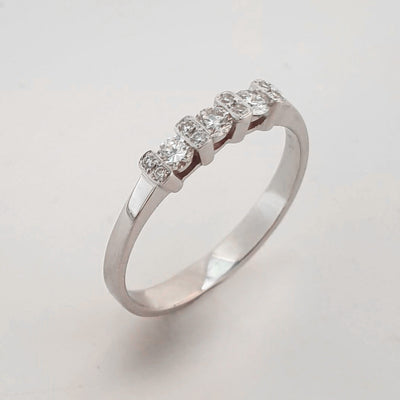
Trilogy ring Traversine in white gold with three brilliant-cut diamonds, twenty-four centigrams total
€1.230,00

Daisy necklace in white gold, eight diamonds around the central ruby
€1.200,00
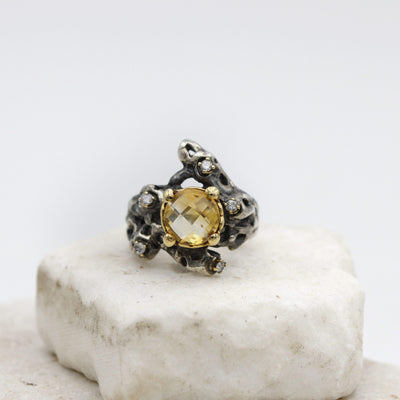
Marte ring in silver and gold with checkerboard citrine quartz and gray diamonds
€1.215,00