Amethyst
At the center of each earring, on four gold claws
- Cut
- Faceted, checkerboard crown
- Carats
- ct 8,00
- Note
- Total for the pair

Collection Marte·Orecchini
Eight carats of amethyst inside a silver crust pitted with craters.
Drawn and built by hand at the bench, in Tosi.
The body of each earring is a crust of oxidized silver, pierced with round holes of different sizes and swollen with raised areas between one hole and the next: a surface of craters, which suits a collection named after Mars. At the center, held by four yellow gold claws, is the amethyst, its crown checkerboard-cut: the light does not all leave on the same side, it breaks up in the small squares. In the silver, around the stone, the diamonds are set one by one, and a few grains of yellow gold come back on the edges.
Eight carats of amethyst, and beneath it two metals that do not behave the same way: eleven grams ten of silver, seven sixty of eighteen-carat gold. The natural brilliant-cut diamonds come to twenty-one points of a carat in all, color F and clarity VS1. Two centimeters by two point three: the earring sits whole on the lobe, and fastens with a post and a shepherd's hook.
Weights and carats as the workshop declares them.
At the center of each earring, on four gold claws
Natural. Position, cut, carats, colour and clarity.


The words of the trade, one by one, explained to those who do not know them.
I don't look at what others are doing: I would rather create in my own style. That is what makes our jewelry recognizable.
Fabio Gori — Anna Gioielli, Tosi
Every piece leaves the bench made to order: sizes and details are agreed before the work begins.
The goldsmith's workshop is also the place where made-to-measure jewellery is created and family pieces are restored: if you have an idea, or something you want brought back to how it was, that is where it starts.
A goldsmith's workshop in Tosi, on the slopes of the Pratomagno: Anna opened it in 1988, her sons Fabio and Francesco carry it on. Piercing, repoussé, chasing and burin engraving — the Florentine school, with the workshop in full view of the shop.
Due modi di cercare quello che somiglia a questo.

Marte faith ring in silver, 5.50 mm narrow band, pierced on a single row of empty spaces
€140,00

Starfish Marte pendant in oxidized and perforated silver, 38 cm chain included
€130,00

Marte ring in domed silver band, round perforated dome with raised dots
€150,00

Marte ring in domed sphere-shaped silver, perforated dotted shell
€220,00
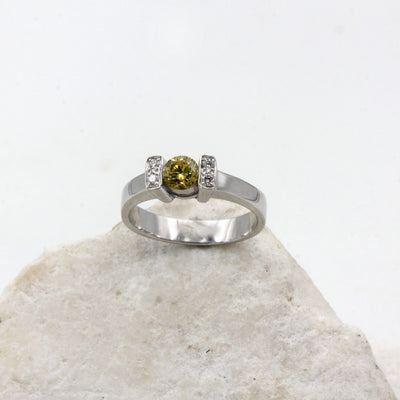
Traversine Solitaire Ring in White Gold with Natural Yellow Diamond
€2.800,00

White and yellow gold band ring with diamonds, openwork mesh between engraved borders
€3.260,00
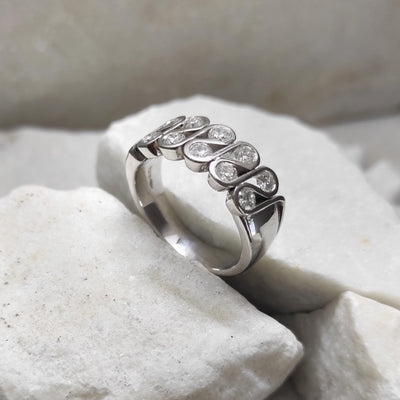
White gold wave ring with ten alternating brilliant-cut diamonds
€3.550,00
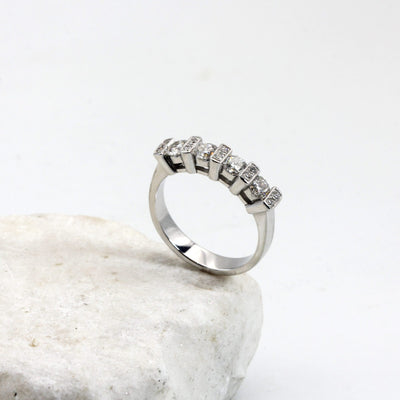
White gold Traversine ring with four 0.20ct brilliant-cut diamonds
€3.530,00


