Amethyst
Single, at the center, in the yellow gold setting
- Cut
- Step-cut octagon
- Carats
- ct 29
- Note
- Natural

Collection Rinascimento·Ring·Florentine mesh work
Twenty-nine carats of natural amethyst, held by a tall, plain yellow gold setting.
Drawn and built by hand at the bench, in Tosi.
At the center there is a single stone, and it takes up the whole top of the ring: a rectangular amethyst with cut corners, step-cut, laid crosswise along the band. It is held by a yellow gold setting bent up from sheet, with a tall satin wall and a polished edge on top. Below the setting the case is silver and it is pierced in a mesh, one window after another on all four sides, and in the silver around the windows a leaf pattern is engraved with the burin. The outline of the case repeats the cut corners of the stone. The band is wide and flat at the shoulders and thins as it goes down, and inside the silver stays smooth.
The amethyst is natural and weighs twenty-nine carats, that is five grams eighty of stone alone: it is the amethyst that dictates the measurements of everything else, because a setting like this is built around a gem that already exists, not the other way round. The eighteen carat gold weighs four grams thirty and is all there, in the setting; the case, the piercing, the leaves and the band are silver at nine hundred and twenty-five thousandths. There are no diamonds; the light is made by the steps of the cut, which do not multiply the sparkle but show the color all at once.
Weights and carats as the workshop declares them.
Single, at the center, in the yellow gold setting


The words of the trade, one by one, explained to those who do not know them.
I don't look at what others are doing: I would rather create in my own style. That is what makes our jewelry recognizable.
Fabio Gori — Anna Gioielli, Tosi
Every ring is made to the size of the person who will wear it: we settle it together before work begins.
The goldsmith's workshop is also the place where made-to-measure jewellery is created and family pieces are restored: if you have an idea, or something you want brought back to how it was, that is where it starts.
A goldsmith's workshop in Tosi, on the slopes of the Pratomagno: Anna opened it in 1988, her sons Fabio and Francesco carry it on. Piercing, repoussé, chasing and burin engraving — the Florentine school, with the workshop in full view of the shop.
Two ways to find pieces like this one.

Acantus leaf carved filigree band ring in silver
€300,00

Florentine Style silver ring with 16.50 ct oval citrine quartz and sixteen surrounding citrines
€1.380,00

Asymmetric Rinascimento ring with cushion-cut amethyst, off-center gold bezel on filigree silver
€1.490,00

Rinascimento silver and gold ring with oval amethyst and gray diamonds, leaf filigree
€2.030,00

Fiore d'Inverno ring in silver with amethyst and yellow enamel, 14 mm corolla
€120,00

Fiore d'Inverno ring in bronze with garnet, blackened corolla and hammered band
€120,00

Marte faith ring in silver, 5.50 mm narrow band, pierced on a single row of empty spaces
€140,00

Fiore d'Inverno Ring in silver with citrine quartz, sinuous hammered wire shank
€150,00

Marte ring in silver with oval coral and eight gray diamonds, gold bezel
€1.610,00
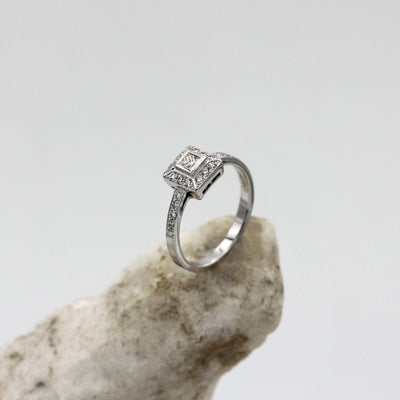
White gold Square ring with Princess diamond, brilliant-cut diamond halo and shank
€1.805,00

Marte ring in silver, pierced dome with a round coral and six gray diamonds
€1.470,00

Marte silver ring with round coral and eight gray diamonds, gold bezel
€1.480,00