Cubic zirconia
At the junctions of the piercing, on the face of the heart and on the bail
- Cut
- Brilliant
- Note
- 52 stones; the carat weight and the origin are not stated by the company

Collection Jewels of Firenze·Pendant·Florentine style, lozenge piercing
Fifty-two cubic zirconia at the junctions of a lozenge mesh that pierces the heart right through.
Drawn and built by hand at the bench, in Tosi.
A silver heart, domed on both faces, hollow inside. On the front the plate is pierced right through in a regular mesh of lozenges, and at every junction of the mesh there is a small square with a zircon set into it; around each small square the burin opens a sunburst of grooves, so that between one void and the next the metal is never left smooth. The edge of the heart is a satin band, and the rays reach up to it, right to the line. Behind, the silver becomes solid and satin again, and at the center a second heart-shaped window opens: through it you see the back of the piercing, where the small squares are empty and only the sunbursts are left. Below, on the satin, is the plate with the hallmarks. The bail is wide, bent into a cone, pierced with the same pattern and set as well; underneath, a single small ring holds the heart and lets it swing. The chain is a rope chain, twisted.
Twelve grams of silver at nine hundred and twenty-five thousandths for a heart of thirty millimeters by thirty-three, measured with the bail: for a pendant pierced across its whole face that is a high weight, and it is not in the mesh, it is in the back and the edge, which stay solid and carry the piercing. The cubic zirconia are fifty-two, brilliant-cut, set one by one; the carat weight the company does not state, and we do not add it. «Zirconi» is the word used by whoever made the piece, and it is the word we use too: in Italian it covers both zircon, which is a natural mineral, and cubic zirconia, which is grown in a laboratory, and which of the two this is is not written down. The rope chain is named together with the pendant and described with its own measurements: silver at nine hundred and twenty-five thousandths, three grams and ninety, forty-nine and a half centimeters. On request the same model is made in eighteen-carat gold, with brilliants in place of the cubic zirconia.
Weights and carats as the workshop declares them.
At the junctions of the piercing, on the face of the heart and on the bail


The words of the trade, one by one, explained to those who do not know them.
I don't look at what others are doing: I would rather create in my own style. That is what makes our jewelry recognizable.
Fabio Gori — Anna Gioielli, Tosi
Every piece leaves the bench made to order: sizes and details are agreed before the work begins.
The goldsmith's workshop is also the place where made-to-measure jewellery is created and family pieces are restored: if you have an idea, or something you want brought back to how it was, that is where it starts.
A goldsmith's workshop in Tosi, on the slopes of the Pratomagno: Anna opened it in 1988, her sons Fabio and Francesco carry it on. Piercing, repoussé, chasing and burin engraving — the Florentine school, with the workshop in full view of the shop.
Two ways to find pieces like this one.

Mesh openwork silver heart pendant with twenty-nine cubic zirconia and sliding chain
€440,00

White and yellow gold cross pendant, openwork and hand-engraved leaves
€1.260,00

White and yellow gold band ring with diamonds, openwork mesh between engraved borders
€3.260,00
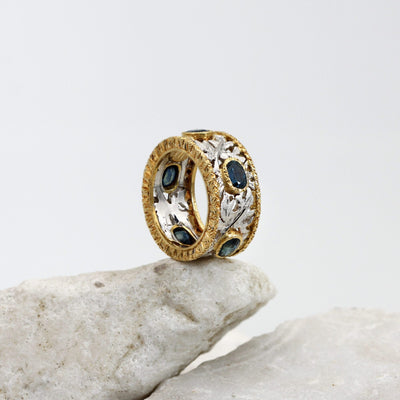
White and yellow gold wedding band with sapphires and floral openwork
€3.990,00

Silver pendant with cabochon amethyst drop and faceted oval peridot, chain included
€120,00

Starfish Marte pendant in oxidized and perforated silver, 38 cm chain included
€130,00

Hammered silver heart pendant with two-tone purple enamel rhombuses, silk cord included
€180,00

Open teardrop silver pendant with freshwater pearl, on a green silk cord
€175,00
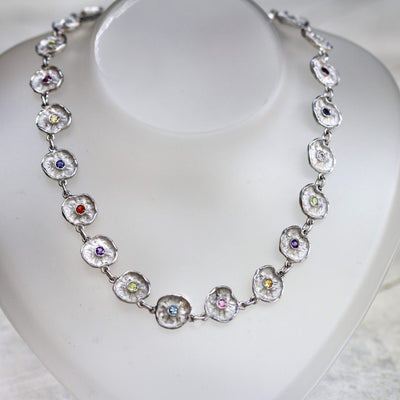
Fiore d'Inverno necklace in silver with twenty-two corollas, one colored stone per flower
€1.100,00
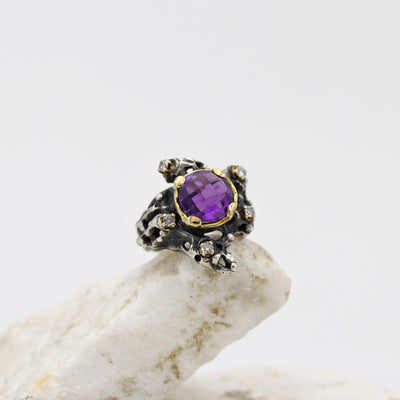
Marte ring in silver and gold with chessboard amethyst and gray diamonds
€1.110,00

Marte ring in silver with branches with oval turquoise and six gray diamonds in gold settings
€750,00

Silver Marte pendant with oval coral and five diamonds on gold claws
€700,00