
Collection Prestige·Earrings·Florentine style
Prestige cushion earrings with openwork frame, twisted collarino, and clip closure
Nine grams and seventy-five of gold, and behind it a spring clip instead of the butterfly back.
Drawn and built by hand at the bench, in Tosi.
Each earring is a square domed cushion, hollow inside and pierced right through. On the face four ribs run from the corners and meet at the center, where a brilliant sits in a closed round setting: each rib carries a row of small diamonds, and between one rib and the next the metal is opened into teardrops and rounds, with burin rays running out from the center. Above the cushion there is a small collar of twisted wire wound into a spiral, and behind it a hinged gold bow that snaps onto the post: they close as clips, with no butterfly back. The reverse too is engraved with a sunburst, where nobody looks.
Nine grams and seventy-five of eighteen-carat gold, and natural brilliant-cut diamonds: thirty points for the ones at the center, forty-four for those around them. The small stones all sit on the ribs, that is, on the only solid metal left after the piercing: that is where you set, and every seat opened takes thickness away from the very relief that holds the cushion up.
The material
Weights and carats as the workshop declares them.
- Metals
- Gold 18kt 750‰
- Style
- Florentine style
- Technique
- Worked by hand in the Tosi goldsmith's studio, using piercing and burin engraving.
The diamonds
Natural. Position, cut, carats, colour and clarity.


How it is made
The words of the trade, one by one, explained to those who do not know them.
- Openwork
- The metal is drilled and then cut away from the inside with a very fine saw blade, until the solid plate becomes a design of voids. It is a process that allows no second attempt: what is taken away does not come back.
- Burin engraving
- The burin is a goldsmith's small chisel pushed by hand. It does not scratch: it lifts a shaving of metal and leaves a clean groove that catches the light. It is the mark that for five centuries has set the Florentine goldsmiths' school apart.
- Twisted wire, wound
- Two drawn wires twisted together become a cord, and the cord is wound in a spiral around the collar, turn over turn, until it closes it. The turns have to stay parallel and at the same distance, because a spiral is read all at once and the turn that is out of step shows before the design does. And when the end is soldered, the rest of the cord is already in position: the heat has to go where it is needed and not a millimeter further, because a thin wire heated twice collapses.
- Clip fastening with a post
- Behind the earring there is a hinged gold bow that folds over the post and snaps shut, in place of the butterfly back that slides off. The lobe is held between two parts that press against one another, so a piece with weight does not tip forward as it would on a post alone. The spring is what decides: too stiff and it marks the lobe, too soft and it opens by itself at the bottom of a pocket. It is adjusted by bending the bow very slightly and trying it on, because on the bench that measurement does not exist.
- Brilliant cut
- Fifty-seven facets calculated so that the light entering from above comes back out the same way. It is the cut that makes a diamond sparkle, and the reason a badly cut diamond stays dead.
I don't look at what others are doing: I would rather create in my own style. That is what makes our jewelry recognizable.
Fabio Gori — Anna Gioielli, Tosi
Made for you
Every piece leaves the bench made to order: sizes and details are agreed before the work begins.
The goldsmith's workshop is also the place where made-to-measure jewellery is created and family pieces are restored: if you have an idea, or something you want brought back to how it was, that is where it starts.
A goldsmith's workshop in Tosi, on the slopes of the Pratomagno: Anna opened it in 1988, her sons Fabio and Francesco carry it on. Piercing, repoussé, chasing and burin engraving — the Florentine school, with the workshop in full view of the shop.
From the same family
Two ways to find pieces like this one.
-

Prestige pendant in white and yellow gold, openwork cushion with integrated chain
€2.810,00
-

Prestige white gold stud earrings, openwork cushion with central brilliant-cut diamond
€2.950,00
-

Gold and diamond bracelet, Florentine craftsmanship
€9.300,00
-

Prestige ring in white and yellow gold, openwork mesh with GIA certified Princess diamond
€6.070,00


From the same hands
See all (189)-

Marte silver ring with rectangular lapis lazuli plate
€250,00
-
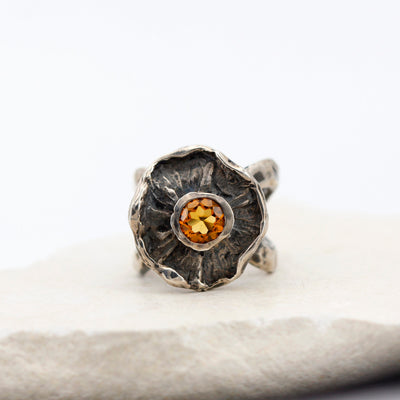
Fiore d'Inverno ring in silver with citrine quartz, crossover shank
€200,00
-
Prestige ring in white and yellow gold, openwork mesh with GIA certified Princess diamond
€6.070,00
-
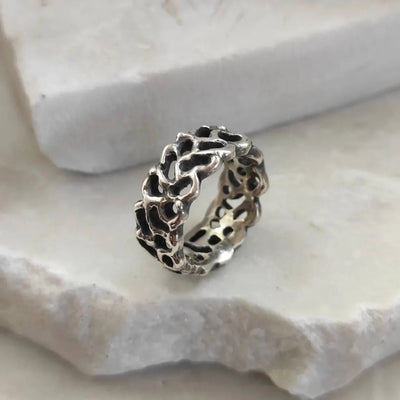
Marte wedding band ring in silver, straight band, perforated with two rows of large voids
€150,00

