Turquoise
At the center, in a silver setting closed all the way round
- Cut
- Oval cabochon
- Note
- Natural

Collection Marte·Ring
Sixteen grams of silver pierced into craters, and thirty hundredths of a gram of gold: enough for the eight diamond settings and nothing more.
Drawn and built by hand at the bench, in Tosi.
The turquoise is an oval cabochon, pale blue, domed and polished without a single facet: the light does not go in, it stops on the curve, and up close you can see slightly darker veining pass through it. It is closed by a continuous silver setting, its rim folded over the stone into an irregular lip — thicker in one place, thinner in another — and re-polished, so the bright line runs all the way round the blue while the rest stays black. Around it the silver is oxidized and pierced right through: round and oval craters of different sizes covering the head, running down the flanks and continuing along the shank, which does not become smooth again but stays pierced right under the finger. The eight gray diamonds make a full circuit of the stone, each raised in its own four-claw yellow gold setting, at distances never twice the same. From below the head is open: you look inside the ring and see the rough back of the turquoise.
Sixteen grams of silver at nine hundred and twenty-five thousandths against thirty hundredths of a gram of eighteen-carat gold: the silver weighs more than fifty times the gold, and the gold is only in the eight settings. Here it does not carry the structure, it holds only the small stones, and it is where the eye goes. The eight natural gray brilliant-cut diamonds add up to twenty-five points of a carat: a little over three points each, so not stones to be counted one by one but eight points of light closing the circle around the blue. The turquoise is stated to be natural, and it remains a soft, porous stone — it scratches easily and drinks in whatever it touches — so the ring comes off before creams, perfumes and detergents: a blue that goes dull does not come back.
Weights and carats as the workshop declares them.
At the center, in a silver setting closed all the way round
Natural. Position, cut, carats, colour and clarity.


The words of the trade, one by one, explained to those who do not know them.
I don't look at what others are doing: I would rather create in my own style. That is what makes our jewelry recognizable.
Fabio Gori — Anna Gioielli, Tosi
Every ring is made in the size of the person who will wear it: we work it out together before the piece is made.
The goldsmith's workshop is also the place where made-to-measure jewellery is created and family pieces are restored: if you have an idea, or something you want brought back to how it was, that is where it starts.
A goldsmith's workshop in Tosi, on the slopes of the Pratomagno: Anna opened it in 1988, her sons Fabio and Francesco carry it on. Piercing, repoussé, chasing and burin engraving — the Florentine school, with the workshop in full view of the shop.
Two ways to find pieces like this one.

Marte faith ring in silver, 5.50 mm narrow band, pierced on a single row of empty spaces
€140,00

Starfish Marte pendant in oxidized and perforated silver, 38 cm chain included
€130,00

Marte ring in domed silver band, round perforated dome with raised dots
€150,00

Marte ring in domed sphere-shaped silver, perforated dotted shell
€220,00

Fiore d'Inverno ring in silver with amethyst and yellow enamel, 14 mm corolla
€120,00

Fiore d'Inverno ring in bronze with garnet, blackened corolla and hammered band
€120,00
Marte faith ring in silver, 5.50 mm narrow band, pierced on a single row of empty spaces
€140,00

Fiore d'Inverno Ring in silver with citrine quartz, sinuous hammered wire shank
€150,00

Marte ring in oxidized silver and gold with oval cabochon amethyst and eight colored stones
€760,00
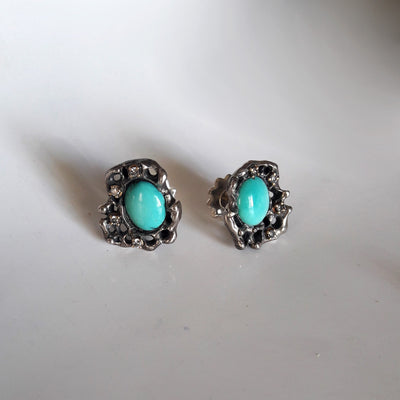
Marte earrings in oxidized silver with oval cabochon turquoise and eight gray diamonds in gold bezels
€680,00

Marte ring in oxidized silver with oval cabochon ruby and eight gray diamonds in gold bezels
€1.080,00

Sterling silver parrot head ring with yellow and white enameled feathers and blue diamonds in the eyes
€650,00